Citi AI Summit 2026: Building, governing and scaling agents in the enterprise

Managing Director, Citi Ventures
Citi AI tools helped summarize the following discussion highlights.
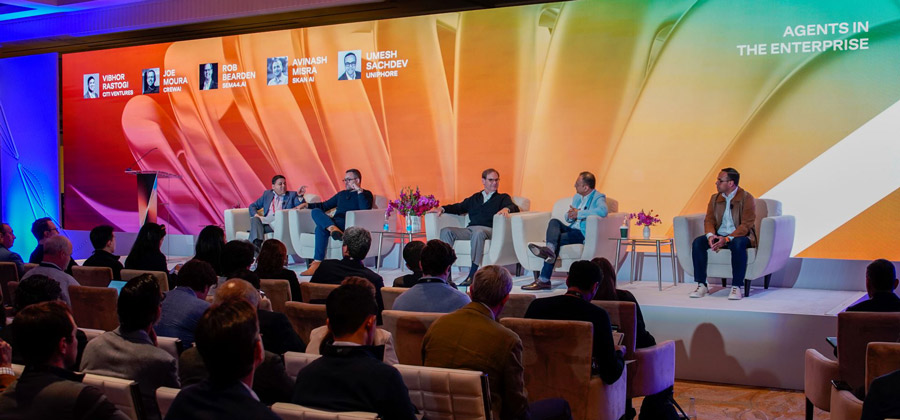
This panel offered an inside look at where agentic AI stands inside today's enterprise.
Rather than focusing on futuristic promises or sweeping claims of workforce disruption, the conversation centered on how companies are deploying agents in real time, where they are seeing real returns and what is slowing broader adoption. The prevailing message was clear: enterprise leaders see the transformative potential of agents, but success depends on careful selection of workflows, strong governance and realistic expectations about effort, risk and value.
Joining the conversation were: Joe Moura, CEO and Founder, CrewAI; Rob Bearden, CEO, Sema4.ai; Avinash Misra, Co-Founder and CEO, Skan AI; and Umesh Sachdev, CEO, Uniphore.
Where to start with agents?
Panelists emphasized that agents create value when applied to well defined workflows with clear inputs, deterministic outcomes and measurable results. Enterprises are not looking to automate everything at once. Instead, they are identifying specific functions, often in the back office, where agents can be deployed safely, scaled reliably and justified economically. CFO oriented workflows surfaced repeatedly as early winners, particularly areas like revenue forecasting, procure to pay and document heavy financial operations where accuracy is non negotiable and the structure of the work lends itself to agentic execution.
A recurring theme was that while enterprise interest is strong, most organizations are still early in their adoption curve. Panelists described a “leg in” phase underway across large companies: teams are testing agents in contained environments; learning how to measure outcomes; and grappling with how to deploy these systems securely and in regulated contexts. The optimism is real, but so is the recognition that high velocity, enterprise wide adoption is still a multi quarter journey rather than an overnight shift.
One of the most important insights concerned the difference between building an agent and running one in production. Getting an agent live is only a fraction of the work. The majority of effort comes after deployment: maintaining the agent, refining its behavior, monitoring its decisions and ensuring it stays aligned with policy and business objectives. Panelists noted that enterprises that treat agent deployment as a one time implementation are often surprised by the ongoing operational demands: iteration, governance and oversight are not optional but instead where most of the work and value creation actually occur.
The need for context layers
This operational reality ties closely to another theme that emerged repeatedly: context. Panelists stressed that agents only perform well when they are grounded in explicit, machine readable understandings of how work is actually done inside organizations. Without capturing this “language of work” in a structured form, what happens, in what order, with what decisions and dependencies, agents remain generic and unreliable. Panelists framed building this context layer, often described as a context graph or context plane, as both the hardest and most valuable part of enterprise agentic deployment.
Relatedly, the discussion emphasized the importance of distinguishing between different types of work. Not all enterprise tasks should be automated in the same way. Some work is deeply judgment based and, therefore, best performed by human. Other work is repetitive but still requires human sign off. Last, some work is repetitive enough to run autonomously once properly governed. Panelists noted that many enterprise failures with AI come from not making these distinctions upfront. Successful agents are matched deliberately to the right category of work, with clarity about where humans remain in the loop and where they do not.
Governance is now front and center
Governance emerged as another central theme, particularly when addressing the need to surveil and control agents more rigorously than traditional software. Enterprises require visibility into how agents act, why they made particular decisions and when to intervene or escalate to a human. This has led to frameworks centered around control loops and context loops: mechanisms for deciding when agents should act independently, when they should pause for human input and how their behavior is monitored over time. The consensus was that trust in agents is earned through operational transparency, not model performance alone.
Agentic pricing and scaling
On the commercial side, the panel made it clear that pricing models are in flux. (Two previous articles from Citi Ventures have explored this topic, highlighting key issues and surfacing CEO insights.) The traditional SaaS seat based model is increasingly mismatched to how agents deliver value. Enterprises do not want to pay for agents the same way they pay for software licenses, particularly when agents function more like intelligence than tools. Pricing experimentation is happening across the market, shaped by customer maturity, risk tolerance and use case. Tokens, usage based economics and outcomes based contracts surfaced as more natural units of value exchange. Several panelists noted that the industry is in an active phase of price discovery, and that segmentation by workflow and outcome will likely determine where pricing ultimately settles.
Finally, the panel addressed how adoption scales once initial success is achieved. Early pilots tend to be cautious and localized. But once enterprises unlock their data and demonstrate tangible ROI in one area, expansion accelerates quickly. What looks incremental at first often becomes exponential, placing the industry at the very beginning of an S curve of enterprise adoption.
In sum, real customers are seeing real returns. But enterprise agentic AI is not a set it and forget it exercise. It requires disciplined workflow selection, deep contextual understanding, strong guardrails and new economic models. Companies that recognize these realities are not just adopting agents but instead redefining how work gets done.
Are you a founder building enterprise-grade AI solutions? I’d love to talk! Reach out to me at vibhor.rastogi@citi.com.