Insights from a look back on 15 years of Citi Ventures

Head of Citi Ventures
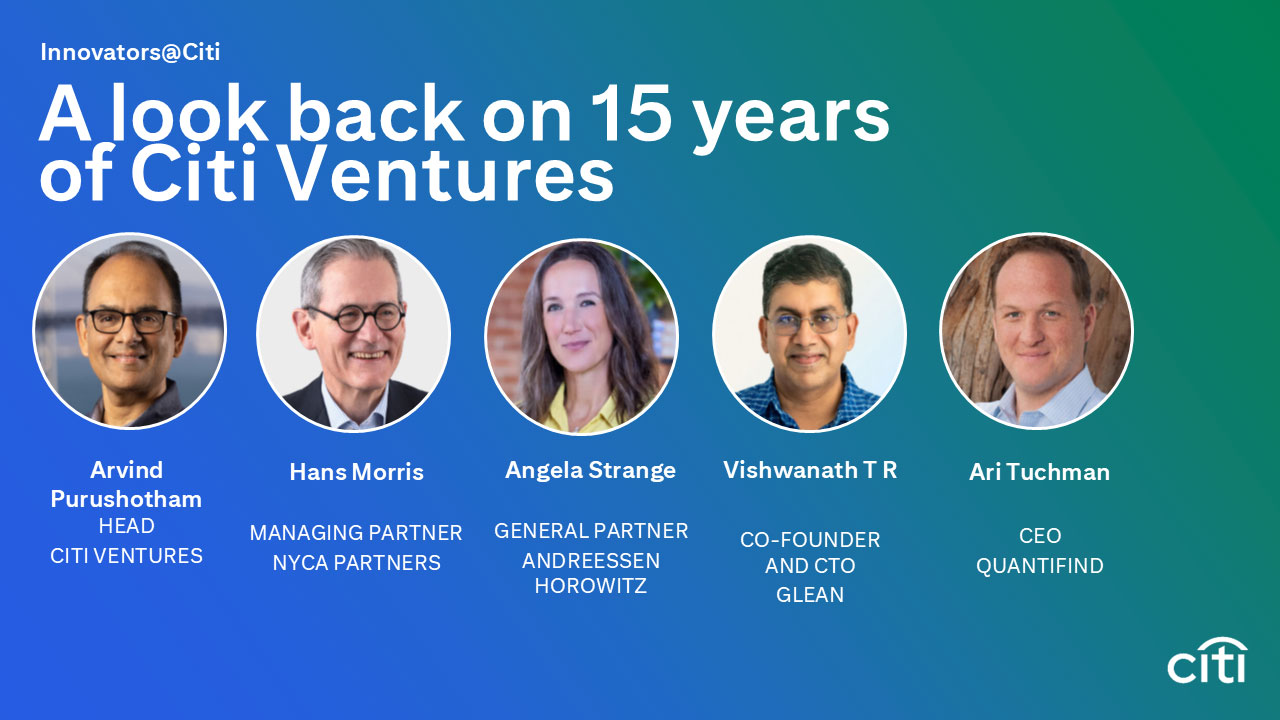
During our latest Innovators@Citi event, I had the pleasure of hosting a panel of founders and venture capital leaders uniquely positioned to discuss the evolution of venture capital during the last 15 years.
My conversation with Hans Morris, Managing Partner, Nyca Partners, Angela Strange, General Partner, Andreessen Horowitz, T.R. Vishwanath, Co-Founder and CTO, Glean and Ari Tuchman, CEO, Quantifind, was not just a look back at Citi Ventures’ 15 years as a corporate VC. It was also an opportunity to reflect on just how much financial services has changed during that time and how the pace of that change is only likely to accelerate, mainly due to new technologies like AI.
Here are my key takeaways from the discussion:
The Evolution of Fintech and
Venture Capital
While some fundamental challenges in financial services persist, technology has significantly influenced fintech and venture capital. Many concepts once seen as novel are now mainstream, including banking as a service (BaaS), data aggregation and cloud-based storage.
“All that infrastructure that [banking] was sitting on was typically 30 to 40 years old and it all needed to be real time and have the type of experiences that both consumers and businesses have grown accustomed to with other types of technology.” ~ Hans Morris
Angela highlighted the succession of product waves that spurred innovation in venture capital and fintech during the last 15 years:
- Internet/PC Wave: Moved offline services, such as lending and payments, online.
- Mobile Wave: Put a "bank in every pocket" with features such as balance transfers and deposits available on any mobile phone.
- Cloud Wave: Enabled any company to become a fintech company through infrastructure and APIs.
- AI Wave: Enhance the power of humans to do more by reducing monotonous tasks and replacing legacy systems.
“The risk of replacing [legacy] systems used to be too high. But now replacement systems are 10x better versus 2x better… and this next wave of companies coming up is particularly exciting.” ~ Angela Strange
The Strategic Role of Corporate Venture Capital (CVC)
Both founders talked about the value of corporate VCs as a strategic partner, especially when navigating large financial institutions. Ari talked about Citi Ventures’ role in helping Quantifind understand Citi’s internal organization.
"Coming out of academia with no knowledge of how to navigate the complexity of a tier one bank, that's where Citi Ventures has been incredibly helpful." ~ Ari Tuchman
Vish said Citi Ventures helped Glean navigate highly regulated environments that require an understanding of applicable regulations and how to comply with them.
“Working with large financial companies requires a lot of understanding of the space. Our [Citi Ventures] partnership has been useful there as well as with talking to other financial companies and making sure Glean as a product can work really well for them.” ~ T.R. Vishwanath
Angela talked about how the best CVCs deliver on the promise of providing access to customers, which is a startup's most critical need.
"What enterprise companies need is big customers. And as anybody who's tried to sell into a bank [knows], it's really hard. It’s 12 different sales. What Citi does particularly well is they actually deliver on that promise.” ~ Angela Strange
The Transformative Impact of AI in Financial Services
Generative AI (Gen AI), LLMs and agentic AI are hot topics in the venture world today. These technologies are creating a paradigm shift, touching everything from regulatory compliance to product development and employee productivity.
Hans said AI can make people more efficient in multiple ways, solve problems in deep verticals and therefore have an instant effect on ROI. Eliminating manual tasks for highly skilled employees, he said, gives them more time to connect with clients and develop business.
Angela outlined three themes that incorporate her perspective on AI:
- Software-for-labor: Automating roles that are hard to hire for, such as compliance.
- Infrastructure replacement: Rebuilding core platforms, such as mortgage servicing, with native AI applications to create better and higher-margin products.
- Internal app building: Empowering business users to build their own AI-powered tools and applications.
Eyeing 2026
The panel ended the discussion by predicting that next year will be about the maturation of AI, particularly agentic AI. Angela expects companies to accelerate agentic AI adoption as they race to outperform one another. The focus will be on how to monetize investments in agentic AI and with other applications of similar technology.
"The technology is already here. If advancement stopped and AI got no better whatsoever, it would take years for all of the large companies to adopt it." ~ Angela Strange