Citi AI Summit 2026: From inner loop to outer loop -- How AI is rewriting enterprise software

Director, Citi Ventures
Citi AI tools helped summarize the following discussion highlights.
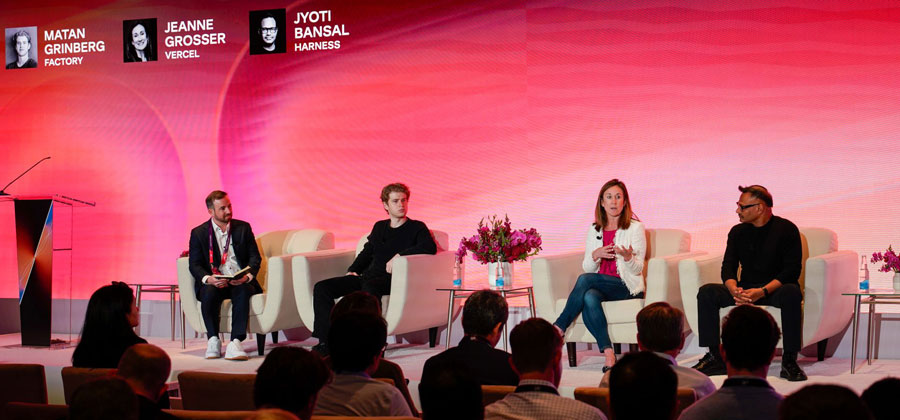
What quickly became clear at this year’s Citi AI Summit was the extent of AI’s sustained influence on software development.
Last year’s conversation focused on how AI will augment code generation and eliminate more routine tasks so engineers can get more hands on and become more strategic. This year, the focus shifted away from code volume and implementation to the need for AI-related infrastructure and governance.
Panelists at this year’s Summit in Menlo Park who gathered to discuss these issues included: Matan Grinberg, Co-founder and CEO, Factory; Jeanne Grosser, COO, Vercel; and Jyoti Bansal, CEO, Harness. Harness is a Citi Ventures Portfolio company.
A rapid transformation
AI is dramatically expanding the amount of software being created, and in doing so, it is shifting where the real constraints lie. Rather than replacing developers, AI is democratizing software creation and raising expectations for what software should be able to do.
Panelists framed this transformation succinctly: everyone is now a developer, including non-technical users and even autonomous agents. As code creation becomes easier, a critical question emerges: who is responsible for ensuring that all of this code actually works?
This reframing set the tone for the rest of the discussion. Historically, writing code, the “inner loop” of development, absorbed much of an engineer’s time. But even before AI, only 30% to 40% of effort was spent actually writing software. The remainder lived in the “outer loop”: testing, security, compliance, deployment and operations. With AI increasing code volume by multiples, that outer loop is now the dominant bottleneck for enterprises.
Agentic AI: Safeguards, governance and infrastrucute
Panelists pushed back on the idea that AI will reduce demand for software talent. If anything, they argued, demand already vastly outstrips supply. AI raises the floor on quality, so no longer is the question whether AI can write software , but whether it can be delivered safely and consistently in production.
That shift becomes even more pronounced in an agentic world, with panelists noting how much easier it is now versus a year ago to build an agent. Now the question is how to run agents safely, manage their access and permissions, control their behavior and prevent unintended consequences. Without proper controls, agents can introduce serious reliability and security risks, they noted.
This need for structure and control is driving demand for a new class of “agentic infrastructure.” These systems are designed specifically to support long running agents, sandboxed environments, model routing, cost tracking and automated recovery. Today, many enterprises are stitching together half a dozen tools just to approximate this functionality. The industry, the panel agreed, is only in the early innings of building a unified stack that can support AI generated code at scale.
Questions of value and ownership loomed large in the discussion, particularly around AI models. Model agnostic architectures are becoming increasingly important, panelists noted, allowing organizations to route different workloads to different models based on performance, cost and reliability. This, however, requires enterprise grade governance: clear protocols defining which teams and agents can use which models and for what purposes.
Build vs buy?
These dynamics are also reshaping the long standing build versus buy equation. As tools improve and costs fall, more enterprises will choose to build internally, especially in areas that are strategically differentiating. Panelists pointed to functions like sales and support as prime examples. Still, they cautioned that not every system will be rebuilt from scratch. Instead, a new generation of vendors will emerge, offering AI native platforms better suited to this environment. The office of the CIO, long focused on procurement and integration, is increasingly becoming a center of engineering capability in its own right.
The panel was candid about winners and losers in this transition. Those who resist automation or assume AI alone will deliver outcomes are likely to fall behind. At the same time, understanding the business and the customer has never been more important. As one panelist noted, the onus is shifting back to business owners to ask the right questions about what truly needs to be shipped. Iterating endlessly is less valuable than delivering the right features.
The panel’s conclusion was clear: AI is not shrinking the software industry, it is expanding it. Code is becoming abundant, but trust, safety and operational excellence are becoming scarcer and more valuable. In that world, DevOps and DevSecOps are no longer secondary concerns. They are the backbone of enterprise software in the age of AI.
Are you a founder building enterprise-grade AI solutions? I’d love to talk! Reach out to me at nick.sands@citi.com.