Key insights on startups, emerging AI business models and Fintech from the latest Innovators@Citi
By Citi Ventures Team
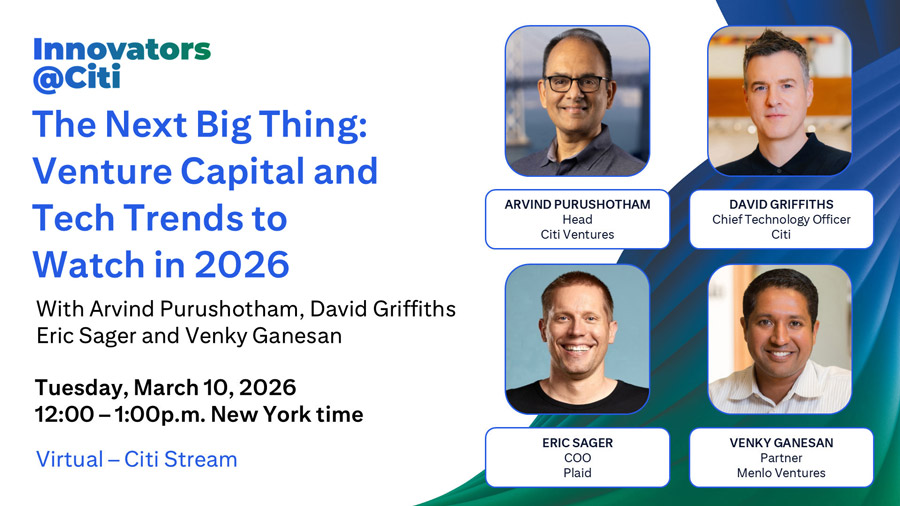
Watch the replay here.
Citi Ventures recently hosted its latest Innovators@Citi session, diving into the venture capital and tech trends to watch in 2026.
Arvind Purushotham, Head of Citi Ventures, brought together a panel to examine the accelerating impact of AI in financial services, as well as the growth of agentic commerce and Fintech's related resurgence. Arvind was joined by David Griffiths, CTO, Citi, Eric Sager, COO, Plaid, and Venky Ganesan, Partner, Menlo Ventures.
The panelists discussed how this year is a fundamental "re-founding moment" for companies formed before 2021, before AI became foundational. They also noted that recent leaps in AI capabilities are as transformative as the initial advent of ChatGPT, fundamentally altering business strategies. Other topics included:
- The commoditization of software development: As AI makes it easier for anyone to build sophisticated applications, traditional technology moats are eroding. In their place, the true differentiators are becoming proprietary data, established customer relationships and deep domain expertise.
- Brands matter: As AI affects barriers to entry in financial services, this creates opportunities for trusted incumbents with proven track records and trust. Panelists noted that companies that do not embrace AI could face stiff headwinds and greater competition in the months and years ahead.
- The conversation also explored the growing role of agentic commerce, how AI is affecting Fintech and the necessary evolution of cybersecurity in the AI era.
Speaker Highlights and Quotes
Arvind Purushotham, Head of Citi Ventures
Arvind noted the optimism surrounding technology entering 2026, driven by the AI revolution. He said that this revolution was simultaneously transforming the internal operations of large enterprises and rewriting the business models for software and Fintechs.
"When we entered the year in 2026, we couldn't help but feel optimistic about the technology trends that we were seeing. First, of course, we started to see the AI revolution take hold in large enterprises. Then we started to see how AI is changing software business models are changing."
David Griffiths, Chief Technology Officer, Citi
David Griffiths discussed the strategic and practical realities of deploying AI within a large, global financial institution. He noted that the recent surge in AI model capabilities represents a sea change, moving beyond simple productivity to enable the solving of highly complex problems.
"I genuinely think the moment we're in, the last month or so, is just as significant as the moment a couple of years ago when these models were first introduced into the ecosystem. And I think the next few weeks and months are going to be truly transformative for companies like ours."
Eric Sager, COO, Plaid
Eric provided a view from the heart of Fintech, where the impact of AI is immediate and tangible. He said Plaid's new customer mix in 2025 showed clear interest from AI companies, an indicator of a fundamental ecosystem shift. He said with the help of AI, established companies can now create more and better products faster than ever, turning their existing assets into powerful competitive advantages.
"If you have the customer, you can build many more amazing products, many more amazing features, both in volume and in quality than you could before, right? It doesn't change. You still have the brand you have, you still have the customer relationships that you have."
Venky Ganesan, Partner, Menlo Ventures
Venky characterized the current environment as a "tale of two cities": the best of times for AI-native companies and the worst for those that cannot adapt. He introduced the concept of a "refounding moment," asserting that any company established before 2021 must be willing to fundamentally rebuild itself from the ground up with an AI-native mindset to survive and thrive.
"For every company that's pre-2021, I say, look, companies have founding moments, and this is a founding moment. 2025, 2026 is the founding moment, where you have to re-found the company and focus and think about it as 'How will I build a company today. If I started the company today, how will I become AI native?'"